


Hey there! As a Teflon rod supplier, I often get asked all sorts of questions about our products. One question that pops up more often than you might think is, "What is the refractive index of a Teflon rod?" Well, let's dive right into it and break this down in a way that's easy to understand.
First off, let's talk a bit about what the refractive index actually means. In simple terms, the refractive index of a material tells us how much light slows down and bends when it travels through that material compared to how it moves through a vacuum. It's a measure of how much the light is refracted, or bent, at the boundary between two different materials.
Now, when it comes to Teflon rods, Teflon is actually the brand name for a synthetic fluoropolymer called polytetrafluoroethylene (PTFE). PTFE is known for its amazing properties like high heat resistance, chemical inertness, and low friction. But what about its refractive index?
The refractive index of PTFE is typically around 1.35 - 1.38 in the visible light range. That's relatively low compared to many other materials. For example, the refractive index of glass can range anywhere from about 1.5 to 1.9, depending on the type of glass. This low refractive index means that light doesn't slow down or bend as much when it passes through a Teflon rod as it would through glass.
Why is this important? Well, in some applications, a low refractive index can be really beneficial. For instance, in optical systems where you want to minimize the amount of light reflection and maximize the amount of light transmission, Teflon rods can be a great choice. The low refractive index helps reduce reflections at the interfaces between different materials, which can lead to clearer images and better overall performance.
At our company, we offer different types of Teflon rods to meet various customer needs. We have Molded PTFE Rod, which are made by a molding process. This results in rods with excellent dimensional stability and surface finish. These rods are great for applications where precision is key, such as in the manufacturing of specialized parts for the medical or electronics industries.
We also have PTFE Extruded Rod. Extrusion is a process where the PTFE material is forced through a die to create a continuous rod. This method allows us to produce rods with consistent quality and length. PTFE extruded rods are often used in applications that require long, straight rods, like in conveyor systems or as guide rails.
And let's not forget about our PTFE Molded Rod. Similar to the molded PTFE rods, these are made using a molding technique. However, the specific molding process we use can give these rods unique properties that make them suitable for different applications. For example, they might have better resistance to certain chemicals or higher mechanical strength in specific directions.
When you're considering using Teflon rods in your project, it's important to think about not only the refractive index but also other properties like mechanical strength, chemical resistance, and thermal stability. Depending on your specific requirements, one type of Teflon rod might be a better fit than another.
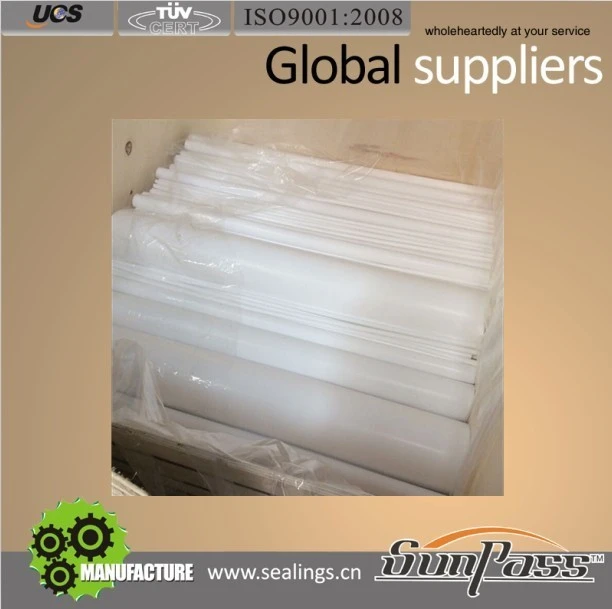

If you're in the market for high - quality Teflon rods, we're here to help. Our team has years of experience in the industry, and we can provide you with all the information you need to make an informed decision. Whether you're working on a small DIY project or a large - scale industrial application, we've got the right Teflon rod for you.
So, if you're interested in learning more about our Teflon rods, or if you have any questions about the refractive index or other properties, don't hesitate to reach out. We're always happy to have a chat and help you find the best solution for your needs. Let's start a conversation about how our Teflon rods can take your project to the next level!
References:
- "Handbook of Polytetrafluoroethylene (PTFE) and Other Fluoropolymers"
- "Optical Properties of Engineering Polymers"


