

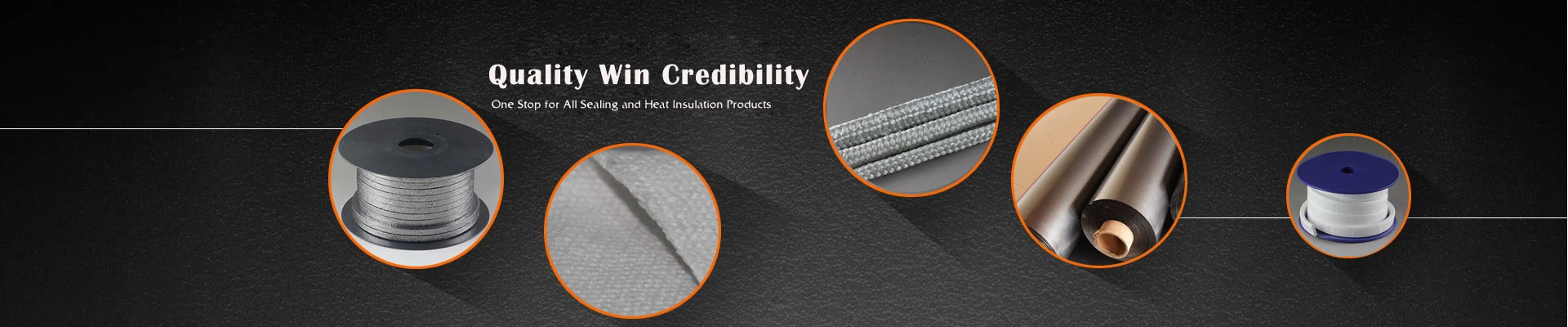
Since its establishment in 1979, our company has established an outstanding reputation in the fields of industrial sealing and insulation materials through more than forty years of mature technology and experience. Currently, we have 178 employees and possess a modern professional plant covering 12,000 square meters, equipped with multiple advanced production lines. We specialize in manufacturing graphite products, PTFE products, seal gland packings, gaskets, fiberglass products, ceramic fiber products, and rubber products. Our products are widely used in various industrial pumps, valves and pipelines, petroleum and natural gas, chemicals and petrochemicals, electricity, food and beverages, paper making and pulp, sugar factories, metallurgy and mining, ships and marine engineering to effectively prevent the leakage of fluids and gases.
Quality Assurance
Quality is our core value. A strict quality management system covers raw material procurement, production process to finished product inspection, ensuring compliance with international standards and customer requirements, winning broad recognition and trust.
Customization Support
We provide comprehensive customization services, tailoring product design, material selection, and size specifications according to specific customer needs, ensuring perfect adaptation to application scenarios. Flexible and personalized services make us stand out.
Professional Team
The company boasts a team of experienced technical experts and professional customer service personnel, including six senior technical experts with over 20 years of industry experience, 87% of customer service staff with more than three years of experience, and eight quality inspectors with over five years of experience, jointly ensuring high quality and excellent service.
Wide Market Coverage
Our products are exported to more than 200 countries and regions worldwide, including Kuwait, Spain, Germany, Russia, Australia, Japan, Korea, and Thailand, demonstrating the international competitiveness and brand influence of our products.
-
![PTFE Encapsulated Graphite Yarn]() PTFE Encapsulated Graphite YarnSUNPASS PTFE Encapsulated Graphite YarnA premium high-performance composite sealing material, meticulously engineered through advanced precision processing to deliver exceptional durability and...read more
PTFE Encapsulated Graphite YarnSUNPASS PTFE Encapsulated Graphite YarnA premium high-performance composite sealing material, meticulously engineered through advanced precision processing to deliver exceptional durability and...read more -
![Graphite PTFE Yarn]() Graphite PTFE YarnThe SUNPASS graphite PTFE yarn is an advanced high-performance sealing material engineered through a sophisticated process where filaments of high-purity, corrosion-resistant PTFE...read more
Graphite PTFE YarnThe SUNPASS graphite PTFE yarn is an advanced high-performance sealing material engineered through a sophisticated process where filaments of high-purity, corrosion-resistant PTFE...read more -
![Temperature With Inconel Wire Flexible Graphite Packing Yarn]() Temperature With Inconel Wire Flexible Graphite Packing YarnSUNPASS 5 glass fiber and 5 stainless steel wire reinforced graphite wire introduction: The flexible graphite wire is made by using expanded graphite and reinforcing materials such as various...read more
Temperature With Inconel Wire Flexible Graphite Packing YarnSUNPASS 5 glass fiber and 5 stainless steel wire reinforced graphite wire introduction: The flexible graphite wire is made by using expanded graphite and reinforcing materials such as various...read more -
![Expanded PTFE Pure Graphite Yarn]() Expanded PTFE Pure Graphite YarnSUNPASS graphite PTFE yarn is made of PTFE and high-pure graphite through special treatment. It is an idea raw material for braiding packings and other sealing products. SunPass can manufacture...read more
Expanded PTFE Pure Graphite YarnSUNPASS graphite PTFE yarn is made of PTFE and high-pure graphite through special treatment. It is an idea raw material for braiding packings and other sealing products. SunPass can manufacture...read more -
![Graphite PTFE Yarn With Oil]() Graphite PTFE Yarn With OilSUNPASS graphite PTFE yarn is made of PTFE and high-pure graphite through special treatment. It is an idea raw material for braiding packings and other sealing products. SunPass can manufacture...read more
Graphite PTFE Yarn With OilSUNPASS graphite PTFE yarn is made of PTFE and high-pure graphite through special treatment. It is an idea raw material for braiding packings and other sealing products. SunPass can manufacture...read more -
![Graphite Yarn With Glass Fiber]() Graphite Yarn With Glass FiberSUNPASS Graphite Yarn with Inconel 600 is well-suited for use in superheated and saturated steam, hydrocarbon, and chemical valves. It features a sacrificial metal corrosion inhibitor to shield...read more
Graphite Yarn With Glass FiberSUNPASS Graphite Yarn with Inconel 600 is well-suited for use in superheated and saturated steam, hydrocarbon, and chemical valves. It features a sacrificial metal corrosion inhibitor to shield...read more -
![Antioxidant Graphite Yarn With Inconel 600]() Antioxidant Graphite Yarn With Inconel 600SUNPASS Graphite Yarn with Inconel 600 ideal for superheated and saturated steam, hydrocarbons and chemicals valves. It Incorporated with a sacrificial metal corrosion inhibitor to protect the...read more
Antioxidant Graphite Yarn With Inconel 600SUNPASS Graphite Yarn with Inconel 600 ideal for superheated and saturated steam, hydrocarbons and chemicals valves. It Incorporated with a sacrificial metal corrosion inhibitor to protect the...read more -
![Graphite PTFE Yarn]() Graphite PTFE YarnSUNPASS graphite PTFE yarn is made of PTFE and high-pure graphite through special treatment. It is an idea raw material for braiding packings and other sealing products. SunPass can manufacture...read more
Graphite PTFE YarnSUNPASS graphite PTFE yarn is made of PTFE and high-pure graphite through special treatment. It is an idea raw material for braiding packings and other sealing products. SunPass can manufacture...read more -
![Graphite Wires yarn]() Graphite Wires yarnSUNPASS Graphite Wires yarn is made by using expanded graphite and reinforcing materials such as various fibers and wires, and adding a binder. Can be used to weave different types of flexible...read more
Graphite Wires yarnSUNPASS Graphite Wires yarn is made by using expanded graphite and reinforcing materials such as various fibers and wires, and adding a binder. Can be used to weave different types of flexible...read more -
![Pure PTFE Yarn]()
-
![Graphite PTFE Yarn]() Graphite PTFE YarnSUNPASS GRAPHITE PTFE YARN Graphite ptfe yarn is made of PTFE and high-pure powdered graphite through special treatment. PTFE graphite yarn has a high strength and low creep and good corrosion...read more
Graphite PTFE YarnSUNPASS GRAPHITE PTFE YARN Graphite ptfe yarn is made of PTFE and high-pure powdered graphite through special treatment. PTFE graphite yarn has a high strength and low creep and good corrosion...read more -
![Expanded Graphite Yarn]() Expanded Graphite YarnSUNPASS Expanded Graphite Yarn Expanded graphite yarn is twisted and treated by special process and treatment. During the process, the graphite is reinforced with threads of cotton or other...read more
Expanded Graphite YarnSUNPASS Expanded Graphite Yarn Expanded graphite yarn is twisted and treated by special process and treatment. During the process, the graphite is reinforced with threads of cotton or other...read more


What is Gland Packing Material
Gland packing is usually made of a flexible material such as braided or twisted fibers. Common materials used for gland packing include graphite, PTFE (polytetrafluoroethylene), aramid, carbon, and various synthetic or natural fibers. The choice of material depends on the specific application, including the type of fluid being sealed and the operating conditions.
Natural Fibers
There are cotton, ramie, and flax for natural fibers. We always supply aramid fiber packing with PTFE impregnation which equips the packing with excellent mechanical properties, resistance to abrasive wear and low friction. The recommended condition is max. With a working temperature of 120℃ with ph 5~9 and a shaft speed of 6m/s. Packing made of natural fibers is often used for clean water, circulation pumps, etc.
Flexible Graphite
It is a type of graphite yarn formed from a thin graphite film which is the basis of the part of gland packing. With its good thermal and chemical resistance, thermal conductivity self-lubricating properties and flexibility, the graphite packing is an excellent seal resistant to heat shocks and overheating, at the same time it generates low friction in all conditions. The recommended working condition is max. A temperature of 450℃ with ph 0~14 and a shaft speed of 40m/s. Graphite gland packing is suitable for dynamic centrifugal pumps for water, petroleum derivatives and other chemicals, especially for high-pressure and high-speed conditions.
PTFE
PTFE is a kind of plastic material with the highest chemical resistance that can withstand strong oxidants and have high thermal resistance and low coefficient of friction. We always supply PTFE-based packing with 100% pure PTFE packing and black PTFE packing (graphited PTFE packing or PTFE packing impregnated with graphite). Graphite PTFE packing provides better-sliding properties and heat resistance, thus it has a longer service life and can withstand higher shaft pressure and shaft speed. The recommended working conditions max. The temperature of 260℃ with ph 0~14 and shaft speed of 15m/s for pure PTFE packing and 25m/s for graphite PTFE packing. PTFE packing is suited to the chemical, pharmaceutical and food industries.
Aramid Fibers
It is a synthetic fiber and always in yellow color. We always supply aramid fiber packing impregnated with lubricant or PTFE dispersion. Aramid packing has an excellent high mechanical resistance and abrasion resistance. The common aramid packing is always a combination of aramid with PTFE sometimes graphite PTFE and in zebra format or aramid corners. The Recommended Working Conditions Max. The Temperature of 260℃ with Ph 3~13 and Shaft Speed of 10m/s.
Carbon Fibers
Carbon fiber is light and durable as well as resistant to high temperatures and abrasion which makes carbon fiber-based packing an excellent dynamic seal. The recommended working conditions are maximum. The temperature of 600℃ with ph 0~14 and a shaft speed of 20m/s. Carbon fiber packing is suitable for the repair and service of industrial and power fittings.
Advantages and Disadvantages of Gland Packing Materials
Advantages:
Natural fiber fillers like cotton and hemp are relatively inexpensive and suitable for large-scale applications. They possess good flexibility and adaptability, effectively filling irregular surfaces. Additionally, natural fibers are renewable resources, and environmentally friendly.
Disadvantages:
They easily decompose or degrade in high-temperature environments, limiting their use in some high-temperature industries. Their resistance to chemicals and solvents is poor, making them susceptible to corrosion. Natural fibers absorb moisture easily, leading to expansion and failure.
Advantages:
Flexible graphite maintains stable performance at extremely high temperatures, suitable for high-temperature environments. It has excellent self-lubricating properties, reducing friction and wear. It shows outstanding resistance to most chemicals and solvents.
Disadvantages:
Compared to some materials, flexible graphite has lower mechanical strength, unsuitable for high-pressure applications. Precise installation is required to ensure sealing effectiveness; Otherwise, leaks can occur. Flexible graphite is more expensive than natural fibers.
Advantages:
PTFE exhibits strong corrosion resistance to most chemicals and solvents, suitable for various chemical environments. It has a very low coefficient of friction, reducing equipment wear and energy consumption. PTFE maintains stable performance over a wide temperature range.
Disadvantages:
At high pressures and temperatures, PTFE may exhibit cold flow, causing seal failure. Professional installation techniques and tools are needed to ensure correct installation. The cost of PTFE is relatively high, increasing usage costs.
Advantages:
Aramid fibers have extremely high tensile strength and abrasion resistance, suitable for high-pressure environments. They are lightweight, and easy to transport and install. Aramid fibers maintain stable performance at high temperatures.
Disadvantages:
Aramid fibers easily absorb moisture, leading to expansion and failure. Their resistance to certain chemicals is poor, potentially causing corrosion. Compared to ordinary fiber materials, aramid fibers are more expensive.
Advantages:
Carbon fibers have extremely high strength and rigidity, suitable for high-load environments. They are lightweight, and easy to handle and install. Carbon fibers maintain stable performance at extremely high temperatures.
Disadvantages:
Carbon fibers are brittle, prone to breaking under impact loads. Their price is very high, increasing usage costs. The processing and installation of carbon fibers require professional skills and equipment.
Guide to Choosing Gland Packing Material
Temperature – Tmax
In the case of dynamic seals, consideration of the Tmax – Maximum temperature is essential for the performance of the sealant. Most materials have a positive temperature coefficient of friction, which means that when a critical temperature is exceeded, the friction starts to increase exponentially. This phenomenon usually leads to overheating and burnout of machine parts and, in the case of seals, to grilling and loss of sealing properties. The temperature of the medium is also not the same as the packing temperature, as the gland operates at a higher temperature due to the friction. A safety margin of at least +50°C is assumed for centrifugal pumps operating without an additional gland cooling system. A good solution is the use of materials resistant to burn-out, based on graphite and carbon fibres. The temperature issue can also be solved structurally by an additional sealant flushing system. However, it does not change the fact that the selection of packing in terms of temperature range is of key importance and its omission may lead to immediate failure of the device.
Pressure and the pV Coefficient
The soft structure of the sealing material does not degrade under the influence of only just factor, i.e. pressure. In dynamic sealants, i.e. pump and valve gland seals, sealant wear is usually caused by friction. This friction is the result of the simultaneous action of movement and pressure in the working gap. With some approximation we can assume that the rate of wear of the dynamic seal is directly proportional to the product of the linear velocity VL and the pressure of the medium p and inversely proportional to a certain dynamic load factor pV, characteristic for a given material. The pV factor is the product of the pressure and linear velocity that can occur simultaneously in a seal using this material. The pV parameter characterises the sealing materials in terms of abrasion resistance and does not generally specify the permissible pressure ranges, which depend to a large extent on the design of the glands themselves, but indicates at which pressures p and shaft speeds V the sealing material will have a comparable service life. Therefore, when assessing the suitability of packing for dynamic applications, it is good to compare the dynamic load factors – pV and not only the permissible operating pressures
The pH Level
To ensure that the packing does not degrade due to the chemical action of the pumped medium or fluids used for flushing or cleaning the system, the maximum pH range to which the packing may be exposed must be determined. As we know, fibre materials, especially natural fibres, rapidly degrade under the influence of corrosive liquids, i.e. in acidic or alkaline environments. Therefore, determining the pH range to which the seal will be exposed is crucial for its durability. It is good practice to use materials with a full pH range of 0 – 14, which excludes natural fibres, of course, but still leaves a lot of material space to choose from and guarantees a large margin of safety.
Shaft Speed
The movement between the shaft and the packing can lead to wear in two ways; by abrasion of the sealant material and by the generation of friction heat and thus thermal degradation of the packing. These phenomena intensify with the increase in VL linear velocity of the shaft; therefore, it is of key importance to determine the working conditions of the packing. Most manufacturers of pumps and equipment specify the shaft speed in rotary motion, determining the number of revolutions per minute (rpm). To calculate the VL linear velocity in the working gap between shaft and packing, use a simple formula: shaft diameter x 3.14 x rpm; to obtain an SI-compliant result in m/s the values in metres should be used for the calculation and the result needs to be divided by 60. The heat of friction is generated when the seal is pressed against the outer surface of the rotating shaft sleeve to form a seal. The higher permitted VL linear velocity of the packing is due to its lower friction coefficient and good impregnation, as well as the higher thermal resistance of the packing itself. Also, homogeneous materials such as expanded graphite and PTFE are better at maintaining the lubricating film on the surface of the sleeve than fibrous materials. In the case of valve glands, the VL linear velocity parameter is not very important, while in pumps, especially centrifugal pumps, it is crucial for the service life of the seal. Therefore, when evaluating packing for pumps, special attention should be paid to this parameter, the better it is, the longer packing operation can be expected. It can be assumed that gland packing intended for centrifugal pumps should meet the condition of the VL linear velocity at the level of 15 m/s.
Condition of Equipment
Attention should be paid to any deficiencies in the mechanical parts. The most common problems are sleeve wear and run-out, but the gland must also be inspected for surface condition and corrosion. The condition and smoothness of the sleeve surface are of key importance for the proper functioning of the packing and make it possible to achieve satisfactory tightness even at lower pressure of the gland, which has a key impact on the level of friction in the working gap, temperature and rate of packing wear.
Flushing System
The design of the gland itself, such as the presence of spacing rings, flushing systems, and cooling or barrier liquid systems, is also an important issue in the selection of packings. These systems protect the seal against abrasive particles, reduce friction and temperature and thus extend the seal life several times over. The use of a higher-performance packing also saves a significant amount of flushing water used in these systems. Glands with a spacing ring can even operate without leakage, provided that the intermediate pressure is properly selected and graphite packing is applied from the atmospheric side.
Economic Issues
The variety of materials that can be used in the construction of packings is enormous, as is the huge spread of prices of these materials. Packing made of hemp rope saturated with grease can be 10 times cheaper than packing based on high-carbon fibres. Undoubtedly, success is ensured by the right choice of packing in terms of working conditions, but also it is necessary to have knowledge and experience of how individual solutions work in a given application. More expensive material will not guarantee longer seal life, the basis is to carry out a practical test. Certainly, the calculation should take into account the costs of downtime and packing replacement, which can often exceed the cost of purchasing even the most expensive gland packing.
Base Components Of Sealants
Of the great variety of sealing materials, only five basic ones are really important for the construction of packings: natural fibres, flexible graphite, PTFE, aramid and carbon fibres. These materials cover more than 90% of the market demand. Each of them has its characteristics, which predestine it for specific applications and make some even irreplaceable material. Another issue in the construction of packings is impregnates, their task is to seal pores and improve sliding properties and heat dissipation. The most effective impregnates are PTFE dispersion and graphite, which can occur in various forms, such as flake graphite or ready-made dispersions in oil. Other popular but less effective impregnates are typical lubricants such as petroleum jelly, oils, and paraffin.
Optimization Factors
The type of application must be taken into account when selecting a packing or when optimising this choice. In this case, the specific operating conditions of the equipment such as high shaft speed in centrifugal pumps, large friction surface in piston pumps, high pressure in valves or high radial stresses in mixers should be considered. There is no universal sealing material, but the specific design features of packings predestine them for specific applications, such as the presence of metal reinforcements in valve sealants or aramid reinforcements in abrasive sealants.
Example of Gland Packing Material


Cotton Yarn
Introduction:
The cotton yarn used in gland packing is core-spun. This type of cotton yarn is typically used for rope and belt cores, featuring specific applications and characteristics that make it suitable as material for packing boxes. Core-spun cotton yarn is chosen for packing boxes due to its specific uses and performance, indicating its likely durability and adaptability, meeting the requirements of packing box usage. Additionally, the cost factor of core-spun cotton yarn may also contribute to its selection as a material for packing boxes.
Advantages:
●Simple and feasible
The structure of packing seal is relatively simple, easy to implement and replace, without the need for complex installation and adjustment processes, making it convenient in practical applications.
●Low cost
Cotton yarn, as a common material, is inexpensive and easily accessible, giving packing seal significant economic advantages, especially suitable for budget-constrained situations.
●Widely available
As a common textile material, cotton yarn has a wide range of sources, meeting large demands and further reducing costs.
Carbon Fiber Yarn
Introduction:
Carbon fiber yarn is new reinforcement fiber, including both carbon feature and fiber limpness or machinability. It is crystallite graphite material after GF organic fiber carbonizing and graphite dealing, such as polyacrylonitrile carbon fiber and asphalt carbon fiber.
Advantages:
●Excellent thermal conductivity and wear resistance
CarbonExcellent thermal conductivity and wear resistance: Carbon conductivity and wear resistance, Carbon fiber yarn has good thermal conductivity and wear resistance, enabling it to maintain stable performance in high-temperature and high-pressure environments, effectively extending its service life.
●Chemical stability
Carbon fiber yarn exhibits outstanding chemical stability, resisting corrosion from acids, alkalis, and other chemicals, making it suitable for various corrosive environments.
●High mechanical strength and low starting torque
Carbon fiber yarn boasts high mechanical strength, is damage-resistant, and its low starting torque design minimizes pump shaft damage, ensuring smooth equipment operation.
Pure PTFE Yarn
Introduction:
PTFE filament yarns made out of pure, virgin PTFE filament. This PTFE filament yarn has good heat resistance, a high tensile strength and is chemically resistant. Additionally it offers low elongation and excellent abrasion resistance characteristics. PTFE filament can be processed into types of high-performance mesh, fabric, sewing thread, dental floss, membrane structure and other products. Thicknesses from 200D to 1200D.
Advantages:
●Excellent chemical resistance
Pure PTFE yarn can with excellent chemical resistance: Pure PTFE yarn can with of acids, alkalis making it widely used in the chemical, pharmaceutical, and food industries.
●Good high-temperature resistance
Pure PTFE yarn has excellent high-temperature performance, capable of long-term operation in extremely high-temperature environments. Its melting point is 327°C, with a continuous use temperature range of -200°C to 260°C, and short-term use temperatures reaching up to 300°C, ensuring stable performance in high-temperature conditions.
●Low friction coefficient
Pure PTFE yarn has an extremely low friction coefficient, providing high efficiency and long service life in the sealing of moving parts. This characteristic makes it widely used in machinery, automotive, marine, and other fields.
●Excellent electrical insulation
Pure PTFE yarn is an outstanding electrical insulation material, capable of stable operation in high-voltage environments. This feature leads to its widespread application in the electronics and electrical sectors.
●Good wear resistance
Pure PTFE yarn exhibits excellent wear resistance, suitable for long-term service under heavy load, high speed, and high-temperature harsh conditions. This characteristic makes it widely used in construction machinery, petrochemicals, and other heavy industries.
Certificate


Frequently Asked Questions
Sunpass Sealing Technology (Zhejiang) Co., Ltd is one of the leading China gland packing material manufacturers and also a famous such supplier, welcome to wholesale cheap and good quality gland packing material from our factory.
hose couplings, fire fighting Equipment, Hydrant Landing Valve-
![Dynamic PTFE Packing With Oil For Valves&Pumps And Agitators]() Dynamic PTFE Packing With Oil For Valves&Pumps And AgitatorsPure PTFE Packing Without Oil is made of 100% white expanded PTFE yarn. It contains no impregnant, has no lubricant,...read more
Dynamic PTFE Packing With Oil For Valves&Pumps And AgitatorsPure PTFE Packing Without Oil is made of 100% white expanded PTFE yarn. It contains no impregnant, has no lubricant,...read more -
![Bulk Fiberglass Texturized Yarn For Filtration System]() Bulk Fiberglass Texturized Yarn For Filtration SystemSUNPASS textured fiberglass yarn is produced using either E-glass fiber filament yarn or C-glass fiber filament...read more
Bulk Fiberglass Texturized Yarn For Filtration SystemSUNPASS textured fiberglass yarn is produced using either E-glass fiber filament yarn or C-glass fiber filament...read more -
![Rubber Sheet | SBR/NBR/CR/EPDM/NR/Silicone Rubber Sheet]() Rubber Sheet | SBR/NBR/CR/EPDM/NR/Silicone Rubber SheetSUNPASS Rubber Sheet product covers five key types, each tailored to specific needs:Natural Rubber Sheets,Neoprene...read more
Rubber Sheet | SBR/NBR/CR/EPDM/NR/Silicone Rubber SheetSUNPASS Rubber Sheet product covers five key types, each tailored to specific needs:Natural Rubber Sheets,Neoprene...read more -
![Dusted Asbestos Yarn]() Dusted Asbestos YarnSUNPASS Dusted Asbestos Yarn, meticulously crafted from premium-grade asbestos fibers through a unique water-based...read more
Dusted Asbestos YarnSUNPASS Dusted Asbestos Yarn, meticulously crafted from premium-grade asbestos fibers through a unique water-based...read more -
![PTFE Braided Manlid Seal]() PTFE Braided Manlid SealSUNPASS PTFE Braided Seal is manufactured from an inert reinforced special fiber yarn, impregnated with PTFE and an...read more
PTFE Braided Manlid SealSUNPASS PTFE Braided Seal is manufactured from an inert reinforced special fiber yarn, impregnated with PTFE and an...read more -
![EPDM Manlid Seal for ISO Tank]() EPDM Manlid Seal for ISO TankMade of pure EPDM, this manhole seal has the elasticity and compression set resistance of EPDM rubber.read more
EPDM Manlid Seal for ISO TankMade of pure EPDM, this manhole seal has the elasticity and compression set resistance of EPDM rubber.read more


