

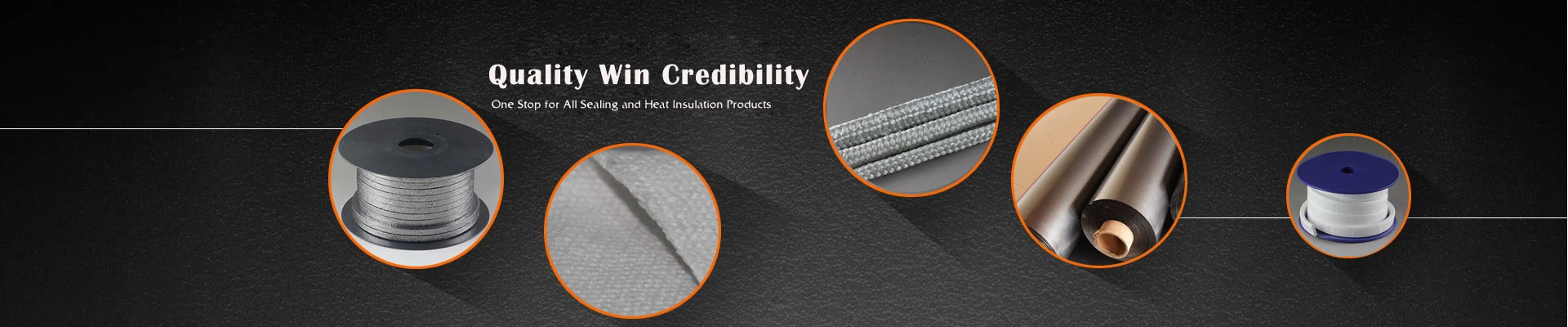
Since its establishment in 1979, our company has established an outstanding reputation in the fields of industrial sealing and insulation materials through more than forty years of mature technology and experience. Currently, we have 178 employees and possess a modern professional plant covering 12,000 square meters, equipped with multiple advanced production lines. We specialize in manufacturing graphite products, PTFE products, seal gland packings, gaskets, fiberglass products, ceramic fiber products, and rubber products. Our products are widely used in various industrial pumps, valves and pipelines, petroleum and natural gas, chemicals and petrochemicals, electricity, food and beverages, paper making and pulp, sugar factories, metallurgy and mining, ships and marine engineering to effectively prevent the leakage of fluids and gases.
Quality Assurance
Quality is our core value. A strict quality management system covers raw material procurement, production process to finished product inspection, ensuring compliance with international standards and customer requirements, winning broad recognition and trust.
Customization Support
We provide comprehensive customization services, tailoring product design, material selection, and size specifications according to specific customer needs, ensuring perfect adaptation to application scenarios. Flexible and personalized services make us stand out.
Professional Team
The company boasts a team of experienced technical experts and professional customer service personnel, including six senior technical experts with over 20 years of industry experience, 87% of customer service staff with more than three years of experience, and eight quality inspectors with over five years of experience, jointly ensuring high quality and excellent service.
Wide Market Coverage
Our products are exported to more than 200 countries and regions worldwide, including Kuwait, Spain, Germany, Russia, Australia, Japan, Korea, and Thailand, demonstrating the international competitiveness and brand influence of our products.
-
![Analog Pocket Thermometer]() Analog Pocket ThermometerThe SUNPASS Analog Pocket Thermometer is a finely crafted, premium quality dial thermometer that features a legible face and distinct gradations, ensuring swift and precise temperature...read more
Analog Pocket ThermometerThe SUNPASS Analog Pocket Thermometer is a finely crafted, premium quality dial thermometer that features a legible face and distinct gradations, ensuring swift and precise temperature...read more -
![Marine Fire Pipe Thread]() Marine Fire Pipe ThreadFire hose and hydrant adapters are critical connection components engineered to securely and reliably couple fire hoses to a variety of essential equipment, including high-flow nozzles,...read more
Marine Fire Pipe ThreadFire hose and hydrant adapters are critical connection components engineered to securely and reliably couple fire hoses to a variety of essential equipment, including high-flow nozzles,...read more -
![Marine Fire Wrench Spanner]() Marine Fire Wrench SpannerMarine Fire Safety Wrench Spanner Description: Spanners are usded for loosening hose to hose connections or hose to appliances and hardware. Applications >Easy to operate >Flexible and...read more
Marine Fire Wrench SpannerMarine Fire Safety Wrench Spanner Description: Spanners are usded for loosening hose to hose connections or hose to appliances and hardware. Applications >Easy to operate >Flexible and...read more -
![Marine Fire Cap]() Marine Fire CapFire Cover Cap Description: Brass fire hose and hydrant caps provide good strength, ductility, and corrosion resistance. They are more heat-resistant than aluminum fire hose and hydrant caps. They...read more
Marine Fire CapFire Cover Cap Description: Brass fire hose and hydrant caps provide good strength, ductility, and corrosion resistance. They are more heat-resistant than aluminum fire hose and hydrant caps. They...read more -
![Marine Fire Connector]() Marine Fire ConnectorFire Shore Connection Description: This is fitted with a coupling to match the hose coupling on the ship Connections come with bolts, nuts, washers and gaskets. The international shore connection...read more
Marine Fire ConnectorFire Shore Connection Description: This is fitted with a coupling to match the hose coupling on the ship Connections come with bolts, nuts, washers and gaskets. The international shore connection...read more -
![Marine Fire Coupling]() Marine Fire CouplingMarine Fire Coupling Description: A hose coupling is a type of fitting located on the end of the fire hose, which is typically made of steel, brass, or aluminum. It's used to quickly connect and...read more
Marine Fire CouplingMarine Fire Coupling Description: A hose coupling is a type of fitting located on the end of the fire hose, which is typically made of steel, brass, or aluminum. It's used to quickly connect and...read more -
![Marine Hose Fire Nozzle]() Marine Hose Fire Nozzle3-position Hose Nozzle Description: Fire hose nozzles play an important part in firefighting. it's designed to be easy to use and keep the water from running out of the pipe. These types of...read more
Marine Hose Fire Nozzle3-position Hose Nozzle Description: Fire hose nozzles play an important part in firefighting. it's designed to be easy to use and keep the water from running out of the pipe. These types of...read more -
![Marine 3-position Hose Fire Nozzle]() Marine 3-position Hose Fire Nozzle3-position Hose Nozzle Description: 3-position nozzles produce shut-off / spray /jet flow spray modes. Nozzle comes with couplings suitable to connect with the hose couplings of the ship. Made of...read more
Marine 3-position Hose Fire Nozzle3-position Hose Nozzle Description: 3-position nozzles produce shut-off / spray /jet flow spray modes. Nozzle comes with couplings suitable to connect with the hose couplings of the ship. Made of...read more -
![Marine Flange Fire Hydrant]() Marine Flange Fire HydrantMarine Flange Fire Hydrant Description: Marine Flange fire hydrant is one of the most important fire-fighting equipments. It can be fixed in factory, warehouse, building and public places. It can...read more
Marine Flange Fire HydrantMarine Flange Fire Hydrant Description: Marine Flange fire hydrant is one of the most important fire-fighting equipments. It can be fixed in factory, warehouse, building and public places. It can...read more -
![Marine Female Thread Fire Hydrant]() Marine Female Thread Fire HydrantFemale Thread Hydrant Description: Female Thread hydrant is the connecter in the water piping network. It's used to offer assistance to control the fire. A hose is attached to the fire hydrant,...read more
Marine Female Thread Fire HydrantFemale Thread Hydrant Description: Female Thread hydrant is the connecter in the water piping network. It's used to offer assistance to control the fire. A hose is attached to the fire hydrant,...read more -
![Marine Lifeboat Light]() Marine Lifeboat LightMarine Lifeboat Light Description: SUNPASS Marine Lifeboat Light unique properties assure superior performance and deliver major benefits resulting in improved plant and equipment maintenance at...read more
Marine Lifeboat LightMarine Lifeboat Light Description: SUNPASS Marine Lifeboat Light unique properties assure superior performance and deliver major benefits resulting in improved plant and equipment maintenance at...read more -
![Marine Portable Oxygen Cylinder Kit]() Marine Portable Oxygen Cylinder KitMarine Portable Oxygen Cylinder Kit Description: SUNPASS Marine Portable Oxygen Cylinder Kit unique properties assure superior performance and deliver major benefits resulting in improved plant...read more
Marine Portable Oxygen Cylinder KitMarine Portable Oxygen Cylinder Kit Description: SUNPASS Marine Portable Oxygen Cylinder Kit unique properties assure superior performance and deliver major benefits resulting in improved plant...read more


What is a Marine Part
Marine parts refer to various components and equipment used on ships. They play a crucial role in the operation, maintenance, and repair of vessels. Spare parts are essential in maintaining the functionality and safety of marine vessels, either being designed to replace or supplement worn-out equipment. With the harsh environments and demanding workloads that marine vessels face daily, having readily available solutions is vital for avoiding the chance of costly repairs and delays.
Precision and Accuracy
Our machines can produce marine parts to very precise specifications, ensuring that the parts fit together perfectly and perform as intended. This precision and accuracy can improve the overall performance of the vessel and reduce the risk of equipment failure.
Durability and Reliability
Marine parts are typically made from high-strength materials, such as stainless steel and aluminum alloys, which can withstand the harsh marine environment and reduce the risk of equipment failure. These parts are also manufactured with strict quality control processes, ensuring that they are reliable and long-lasting.
Efficiency and Performance
Marine parts can be optimized for specific applications, improving the efficiency and performance of the vessel. For example, propeller and rudder assemblies can be designed and manufactured using specific machines to ensure optimal performance, reduce fuel consumption and increase the overall efficiency of the vessel.
Safety
Marine parts can also contribute to the safety of the vessel and its crew. For example, a ship equipped with high-quality, specialist components is less likely to break down, reducing the risk of accidents and increasing the safety of the vessel.
Common Materials for Marine Parts
Stainless Steel
Stainless steel is a popular material for marine parts due to its corrosion resistance, durability, and strength. It is commonly used for propellers, shafts, and other critical components.
Aluminum Alloys
Aluminum alloys are lightweight and have good corrosion resistance, making them a popular choice for marine parts such as hulls, superstructures, and other non-critical components.
Bronze
Bronze is a strong, corrosion-resistant material that is commonly used for propellers, rudder assemblies, and other marine components that require high strength and durability.
Carbon Fiber
Carbon fiber is a lightweight, high-strength material that is commonly used for marine components such as hulls and masts, where weight reduction is critical for improving vessel performance.
Titanium
Titanium is a strong, lightweight material that has excellent corrosion resistance, making it a good choice for marine components that require high strength and durability, such as propeller shafts and fasteners.
High-Density Plastics
High-density plastics, such as polyethene and polypropylene, are lightweight, corrosion-resistant, and have good impact resistance. They are commonly used for non-critical components such as piping, fittings, and cable insulation.
Wash Your Boat Thoroughly After Every Trip
Cleaning your boat from stem to stern, inside and out after each trip is not only important for appearances, but it also helps keep your boat in good working order, preventing water damage, mildew, corrosion, and other issues. It is also a great time to inspect your boat up close, keeping an eye out for potential problems. Leaky hydraulic lines, missing bolts, or screws, frayed or loose wires, and other potential issues can all be discovered while washing and drying your boat. Many boaters wash their boats with liquid dishwashing detergent, which can strip away protective wax. It’s better to use specialized boat soap that removes dirt, salt, and grime without being too harsh. You may need to use a soft bristle brush on the deck to remove ground dirt, fish scales, or dried blood. On smooth fiberglass surfaces, outboard engine cowlings, and metal work, you’ll want to use soft microfiber cloths to avoid scratching or pitting the surfaces. There are many specific cleaners and products designed for different cleaning tasks, such as cleaning the bilge, cleaning polycarbonate windshields and spray screens, polishing aluminium and anodized metalwork, cleaning vinyl upholstery, etc. Contact your local Sierra dealer and ask about pre-assembled boat wash kits to ensure you have the correct products for your boat.
Air-dry Your Boat Before Putting On A Cover
We recommend storing your boat under a quality, custom-fitted canvas cover. But it’s important to let the boat air-dry before adding the cover. Otherwise, you’re inviting the formation of mold and mildew. Open lockers, bait tank hatches, deck hatches, console doors, and other enclosed spaces after washing and let the boat air dry for up to 24 hours before covering.
Keeping Your Boat Covered Whenever It’s Not Being Used
Covering your boat when not in use is the best way to protect it from the elements. It’s worth investing in a premium quality cover that is custom-made for your specific boat. This will ensure a good fit and prevent rainwater, leaves, and dirt from accumulating on the cover during the off-season. If you notice water puddling in low spots on the cover, tighten it up and use braces underneath it to prevent low spots where rainwater and dirt can collect. Use manufacturer-provided covers to protect your helm electronics displays such as MFDs, autopilot control heads, sonar, and other systems during storage.


Protect Your Boat From Sun Damage By Applying Wax
The sun’s UV rays can cause fading and oxidation of your boat’s fiberglass surfaces. Applying a coat of specialized marine wax to your boat twice a year will keep it looking good and prevent your hull and topside gel coat surfaces from becoming chalky. There is a range of Carnauba wax and synthetic polymer wax products available to use.
Gelcoat Repairs
Over time, any fiberglass boat will get nicks, cracks, and gouges in the thin gel coat surface. Gelcoat repair kits are available to help boaters color match and repair damage. These repairs help restore the appearance and prevent water instruction below protective coatings. Most repair kits have detailed instructions. When in doubt, consult your owner manual or contact your local service dealer.
Fix Rusty Parts When You See Them
Always be on the lookout for any spots of corrosion on metal fittings, latches, rod holders, railings, and other metal components. If you find rust, deal with it right away by cleaning, polishing, or replacing affected parts. Look for streaks of rust on fiberglass surfaces. This often indicates where water is getting underneath screws where metal components such as bow rails, door hinges, and flush-mounted rod holders are mounted. Remove these screws, replace them with new stainless-steel hardware, sealing them with a marine bedding compound to prevent further water intrusion.
Caring For Boat Upholstery
Helm seats, leaning posts, coaming pads, lounge seating, and other upholstered surfaces are subject to damage from dirt, sun, and salt. Keeping them clean and dry during storage will go a long way to extending their life. Small tears or cracks can be treated with Liquid Stitch or other sealing products.
Example of Marine Part
Marine Pressure Gauge
Introduction:
Marine pressure gauges are designed specifically to measure pressure within shipboard installations. They can measure the pressure of gases, liquids, and other media that do not corrode copper alloys, crystallize or precipitate. Key features include clear visibility in darkness, resistance to salt spray, operation under tilt and roll conditions, and vibration resistance. These characteristics make marine pressure gauges ideal for use on ships and offshore equipment, ensuring accurate and reliable performance in complex and variable environments.
Advantages:
●Shock-resistance
Marine pressure gauges offer excellent shock resistance, making them ideal for shipboard conditions with mechanical vibrations, ensuring stable and accurate pressure measurement on ships and related equipment.
●Clear visibility in darkness
The main scale and pointer tips of marine pressure gauges are coated with a permanent luminescent agent, allowing for clear observation of readings in the dark, which is crucial for nighttime or low-light conditions.
●Salt spray resistance
Marine pressure gauges have significant salt spray resistance, capable of enduring the GB/T2423.17—1993 specified 48-hour test without noticeable corrosion, ensuring durability in maritime environments.
●Operational under tilt and roll
Marine pressure gauges are designed to function normally under specified tilt and roll conditions, advantageous for the bumpy and rolling environments encountered during navigation.
●Vibration resistance
Marine pressure gauges can operate correctly under vibration conditions with an amplitude of 1mm and a frequency less than 13Hz, ensuring readings remain unaffected by vibrations during ship operation.
Marine Hydrometer
Introduction:
Draught survey hydrometers are used to determine the apparent weight (i.e. the weight in air) of the vessel and from this the commercially accepted weight or apparent density of the cargo on board. These hydrometers are also calibrated at standard temperatures but no temperature correction is required. A small error is introduced if the hydrometer is not at its standard temperature but this is compensated for by a change in the volume of the ship. This change is due to the same temperature difference but the cubical expansion coefficient correction for steel expansion is of the opposite sign to that for glass expansion and the two differences tend to cancel each other out. These hydrometers should not be used for load line purposes.
Types:
●Seawater Hydrometer
This instrument is specifically designed to measure the salinity of seawater. It employs Archimedes' principle and the condition of equilibrium for an object floating on a liquid surface, reflecting salinity levels by measuring the density of seawater at different salinities. The device typically consists of a sealed glass tube with one end uniformly thin, featuring a graduated scale on the inner wall that is uneven, sparse at the top and denser at the bottom. The other end is slightly bulbous, containing small lead pellets or mercury, allowing the tube to vertically submerge to an adequate depth in the liquid under test and to float steadily within it. When the hydrometer floats in the liquid, its own weight equals the weight of the displaced liquid, resulting in varying depths of immersion and pressures depending on the liquid, which the hydrometer uses for its scale calibration.
●Salinity Meter
A salinity meter is another tool used to measure seawater salinity, offering high precision capable of measuring salinity ranges from 0 to 100‰. Salinity meters are commonly used in seawater aquaculture, fisheries, seafood tanks, and aquariums to ensure the water's salinity remains at suitable levels, thereby maintaining ecological balance and promoting biological growth.
Marine Flange Fire Hydrant
Introduction:
Marine flanged fire hydrant valve is a type of firefighting equipment that is specialized for use on ships and is usually installed in the ship's firefighting system. These valves usually have a flange connection for connection to the piping system and also have a hydrant function to provide a source of water to extinguish a fire in the event of a fire. Marine flanged fire hydrant valves are usually corrosion, high pressure and temperature resistant to ensure reliable operation in emergency situations. Marine flanged hydrant valves may also be equipped with a handwheel or handle to allow the operator to quickly open or close the valve.
Advantages:
●Simple structure, easy operation
The design of theSimple structure, easy operation: The design of the hydrant is straightforward, The design of the marine flanged fire hydrant is straightforward, making its operation intuitive and quick to respond to emergencies.
●Good sealing performance
The fire hydrant features excellent sealing capabilities with minimal friction between sealing surfaces, ensuring effective sealing after prolonged use and preventing leaks.
●Long service life
Good sealing reduces wear, extending the fire hydrant's lifespan and lowering maintenance costs.
●Short working stroke, quick opening and closing
This means the fire hydrant can be rapidly opened or closed in emergencies, enhancing response efficiency.
Certificate


Frequently Asked Questions
Sunpass Sealing Technology (Zhejiang) Co., Ltd is one of the leading China marine parts manufacturers and also a famous such supplier, welcome to wholesale cheap and good quality marine parts from our factory.
Pressure Measurement Gauge, fire fighting valve, dixon brass-
![Dynamic PTFE Packing With Oil For Valves&Pumps And Agitators]() Dynamic PTFE Packing With Oil For Valves&Pumps And AgitatorsPure PTFE Packing Without Oil is made of 100% white expanded PTFE yarn. It contains no impregnant, has no lubricant,...read more
Dynamic PTFE Packing With Oil For Valves&Pumps And AgitatorsPure PTFE Packing Without Oil is made of 100% white expanded PTFE yarn. It contains no impregnant, has no lubricant,...read more -
![Bulk Fiberglass Texturized Yarn For Filtration System]() Bulk Fiberglass Texturized Yarn For Filtration SystemSUNPASS textured fiberglass yarn is produced using either E-glass fiber filament yarn or C-glass fiber filament...read more
Bulk Fiberglass Texturized Yarn For Filtration SystemSUNPASS textured fiberglass yarn is produced using either E-glass fiber filament yarn or C-glass fiber filament...read more -
![Rubber Sheet | SBR/NBR/CR/EPDM/NR/Silicone Rubber Sheet]() Rubber Sheet | SBR/NBR/CR/EPDM/NR/Silicone Rubber SheetSUNPASS Rubber Sheet product covers five key types, each tailored to specific needs:Natural Rubber Sheets,Neoprene...read more
Rubber Sheet | SBR/NBR/CR/EPDM/NR/Silicone Rubber SheetSUNPASS Rubber Sheet product covers five key types, each tailored to specific needs:Natural Rubber Sheets,Neoprene...read more -
![Dusted Asbestos Yarn]() Dusted Asbestos YarnSUNPASS Dusted Asbestos Yarn, meticulously crafted from premium-grade asbestos fibers through a unique water-based...read more
Dusted Asbestos YarnSUNPASS Dusted Asbestos Yarn, meticulously crafted from premium-grade asbestos fibers through a unique water-based...read more -
![PTFE Braided Manlid Seal]() PTFE Braided Manlid SealSUNPASS PTFE Braided Seal is manufactured from an inert reinforced special fiber yarn, impregnated with PTFE and an...read more
PTFE Braided Manlid SealSUNPASS PTFE Braided Seal is manufactured from an inert reinforced special fiber yarn, impregnated with PTFE and an...read more -
![EPDM Manlid Seal for ISO Tank]() EPDM Manlid Seal for ISO TankMade of pure EPDM, this manhole seal has the elasticity and compression set resistance of EPDM rubber.read more
EPDM Manlid Seal for ISO TankMade of pure EPDM, this manhole seal has the elasticity and compression set resistance of EPDM rubber.read more


