


1. Product Introduction
FEP/PFA encapsulated O-rings adopt composite sealing construction: the inner elastic rubber core provides compression resilience, and the outer FEP/PFA fluoroplastic layer delivers excellent chemical resistance and anti-swelling performance. It is widely applied in chemical, pharmaceutical, semiconductor, precision fluid equipment and other severe working conditions.
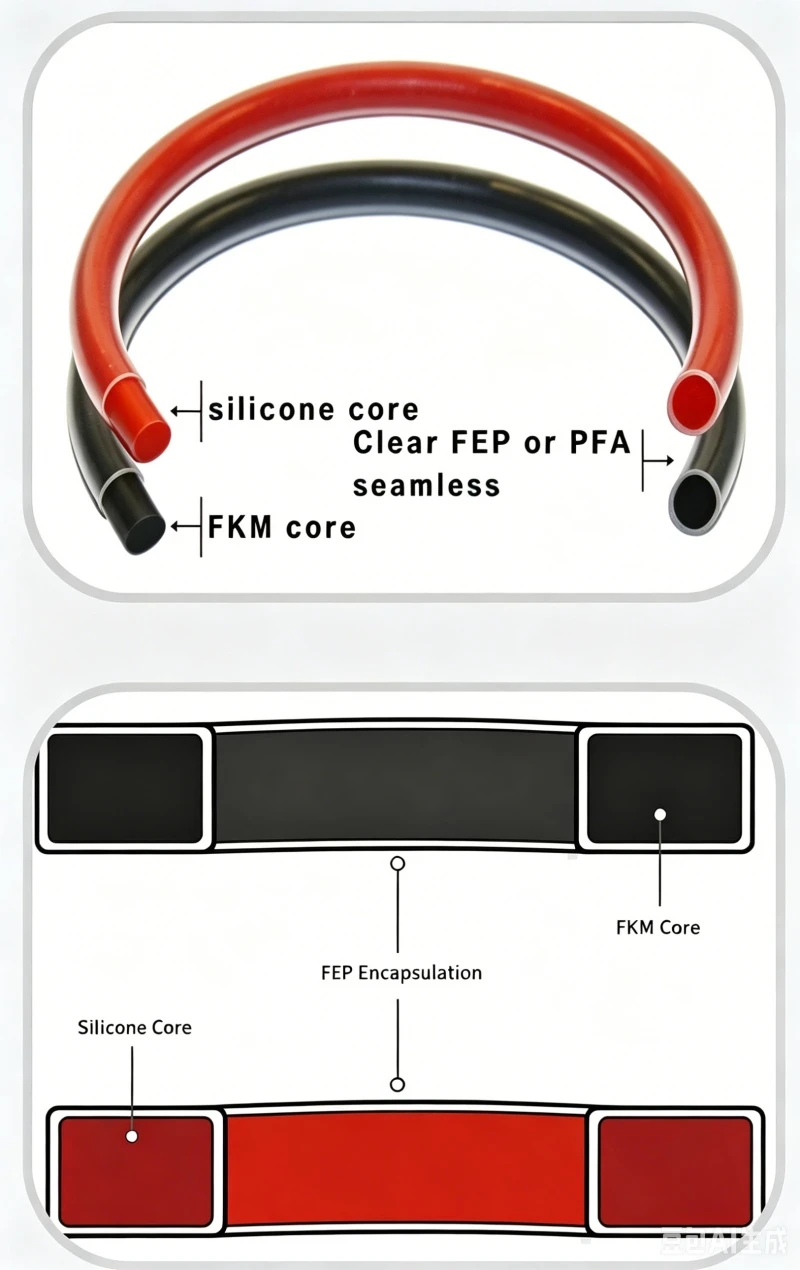
SUNPASS encapsulated O-ring structure
This document focuses on the inherent ovality of small inner diameter & large cross-section encapsulated O-rings. It systematically elaborates deformation mechanism, standardized measurement, calculation methods, service impacts and international gland design compensation schemes, serving as official technical documents for global customers for inspection, engineering design and assembly.
2. Definition of Ovality
Under ambient temperature and unloaded free state, a single circular section presents elongated horizontal (axial) dimension and shrunk vertical (radial) dimension, resulting in dimensional difference between two mutually perpendicular directions, which is defined as ovality.
Ovality is an inherent physical and process feature of this special composite product, not a quality defect. It cannot be completely eliminated by manufacturers worldwide and can only be controlled within allowable tolerances.
During production, SUNPASS uses a laser diameter measuring instrument to perform in-line monitoring of the rubber strip's dimensions (diameter and roundness). The products undergo inspection before leaving the warehouse to prevent production errors.
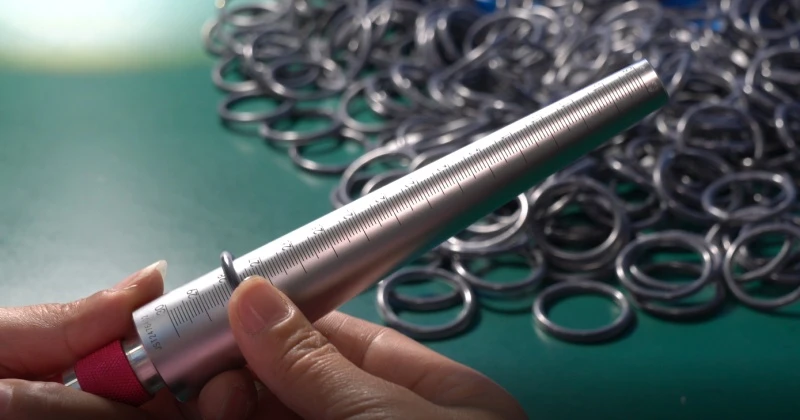
SUNPASS encapsulated O-ring size measure
3. Mechanism of Axial Elongation & Radial Shrinkage
The root cause is the shrinkage stress generated during the cooling process of thick cross-section rubber core after high-temperature molding:
- The inner arc of the ring is short with concentrated shrinkage stress, which squeezes inward vertically and causes reduction of radial section size;
- The outer arc bears tensile stress. The outer FEP/PFA is rigid thermoplastic material with fixed molded shape. The stress can only be released horizontally, leading to passive increase of axial dimension and formation of stable oval shape.
4. Standardized Measurement Methods & Calculation Formulas ( how to measure o rings )
4.1 Pre-measurement Requirements
|
Item |
Standard Requirement |
|
Environment |
Ambient temperature 23℃, product laid flat naturally without stretching, squeezing or external force |
|
Measuring Position |
Measure two mutually perpendicular axial and radial directions on the same circular section |
|
Measuring Tool |
High-precision digital caliper with 0.01mm resolution |
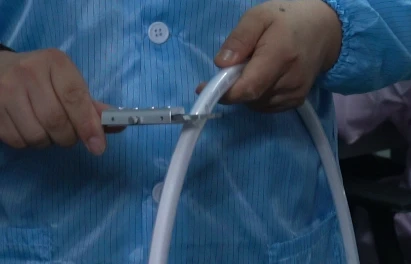
SUNPASS encapsulated O-ring size measure
4.2 Core Calculation Formulas
|
Calculation Item |
Formula |
Application Purpose |
|
Ovality Deviation (QC acceptance index) |
Ovality Deviation = Max Axial Outer Diameter − Min Radial Outer Diameter |
Judge whether the deformation meets qualified tolerance |
|
Equivalent Nominal Size (drawing verification) |
Equivalent Nominal Size = (Max Axial OD + Min Radial OD) ÷ 2 |
Restore the equivalent perfect circle size to verify compliance with nominal drawing dimensions |
4.3 Global Industry Standard Tolerance
|
Product Grade |
Maximum Allowable Ovality Deviation |
|
General Industrial Grade (ISO 3601 Grade N) |
≤0.10 ~ 0.20 mm |
|
High-precision Custom Grade (ISO 3601 Grade S/CS) |
≤0.05 mm |
5. Service Impact Analysis for Different Application Scenarios
|
Application Scenario |
Impact of Ovality |
Recommended Solution |
|
Most static sealing & general reciprocating dynamic sealing |
No adverse effects. The oval shape is completely corrected after gland compression, achieving uniform compression with stable pressure resistance, sealing performance and corrosion resistance. |
Adopt standard glands in accordance with ISO 3601-2 / AS568 / DIN 3771 |
|
High-speed rotary shaft sealing |
Ovality under free state leads to dynamic unbalance, vibration and local frictional heat |
Tighten ovality tolerance; adopt O-ring & back-up ring combined structure |
|
Assembly without dedicated gland, positioned by outer circle |
Prone to assembly offset and poor centering |
Add annular locating shoulder, avoid positioning relying on outer roundness |
6. International Gland Design & Compensation ation Suggestions
6.1 Preferred Universal Solution (Global Compatibility)
Adopt standard rectangular glands complying with ISO 3601-2, AS568, DIN 3771, and select products according to equivalent nominal size. The side walls of the gland can automatically correct oval deformation after assembly, featuring the lowest cost and the strongest global equipment compatibility.
SUNPASS products is controlled within global standard tolerances, and the geometric average equivalent size fully conforms to drawing nominal specifications (metric ISO, imperial AS568, DIN sizes are available).
6.2 Gland Optimization for Products with Relatively Large Ovality Deviation
|
Optimization Item |
Detailed Design Recommendation |
Optimization Purpose |
|
Gland Width Compensation |
Increase axial gland width by the value equal to the maximum ovality deviation of the product |
Prevent excessive compression on the long-axis area and avoid stress damage to the FEP/PFA outer layer |
|
Compression Ratio Adjustment |
Control compression ratio of encapsulated O-rings within 12%~18% (15%~25% for solid rubber O-rings) |
Reduce compression difference between long and short axes to realize uniform circumferential compression |
|
Gland Edge Treatment |
Machine R0.3~R0.5 fillets on gland inlet and bottom corners |
Prevent scratches on fluoroplastic coating at protruding long-axis positions during assembly |
6.3 Customized Structure for Special Sealing Conditions
- High-speed rotary sealing: Apply O-ring + back-up ring assembly to limit radial runout, and implement full inspection with stricter ovality tolerance.
- Non-gland positioning structure: Install annular locating shoulders for axial limitation to completely eliminate positioning deviation caused by oval outer profile.
If you have any further questions, please feel free to contact us directly.SUNPASS offer Free material selection and technical consultation,and we will reply you in 24 hours.
7. Why Choose our Encapsulated O-Rings?
Why choose us?
SUNPASS SEALING TECH, founded in 1979, has 178 employees. Relying on more than 40 years of mature technology and experience, it specializes in the production of industrial sealing and thermal insulation materials. SUNPASS has a high reputation and influence in the sealing industry at home and abroad.
SUNPASS has a modern professional workshop of 12000M2, with more than 20 production lines such as graphite products, PTFE products, sealing gland packing, sealing gasket, glass fiber products, ceramic fiber products, rubber products and so on.
Customers are located in more than 200 countries and regions such as China, Kuwait, Spain, Germany, France, the Netherlands, Saudi Arabia, Russia, the United States, Mexico, Brazil, Australia, South Korea, Japan, Thailand, Egypt, Belgium, etc.
① Quality Raw Materials
- The ovality deviation of SUNPASS products is controlled within global standard tolerances, and the geometric average equivalent size fully conforms to drawing nominal specifications (metric ISO, imperial AS568, DIN sizes are available).
- For high-precision orders, we can provide test reports including measured long/short axis data, ovality deviation and equivalent nominal size, and support full sorting inspection.
- All products pass air tightness, pressure resistance and appearance inspection, with intact outer coating free of delamination and cracks, 100% qualified sealing performance.
② Production Control
To ensure consistent product quality, strict quality control points are established throughout the entire manufacturing process.
- Online laser diameter measuring instruments are used to continuously monitor cord diameter, roundness and surface cleanliness.
- High-precision CNC encapsulation equipment ensures that the FEP or PFA film is wrapped around the elastomer core under constant tension and a controlled overlap ratio, typically between 50% and 60%.
- Special attention is paid to the sealing seam area to ensure smooth transitions without PTFE burrs, wrinkles or elastomer overflow.
Compared with ordinary encapsulated O-rings, SUNPASS products feature highly transparent FEP jackets, less visible seams, improved core elasticity and superior sealing performance.
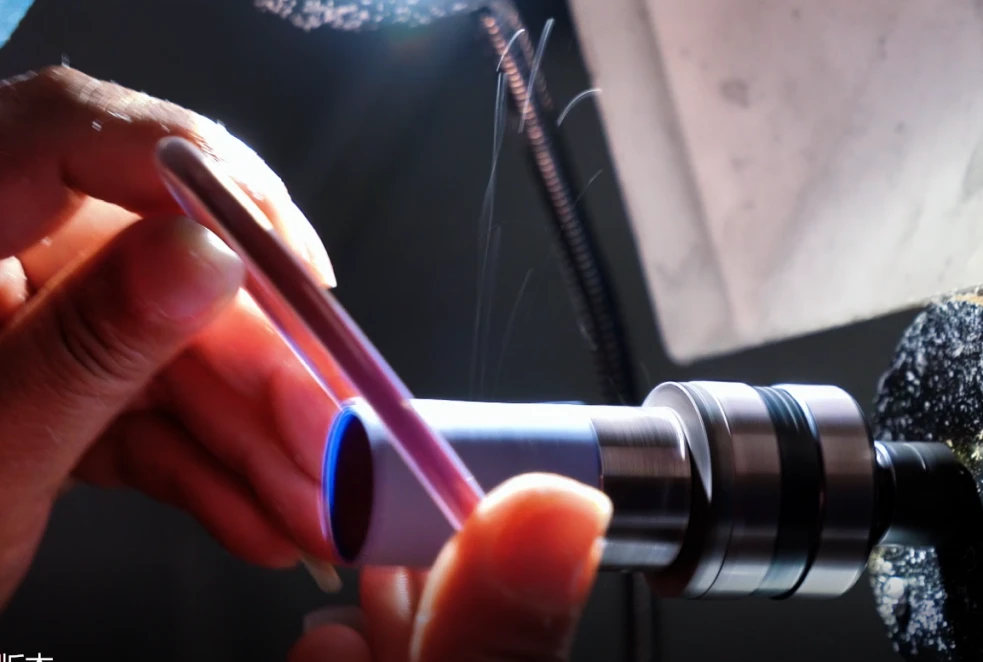
The dense encapsulation structure effectively blocks the penetration paths of gases, liquids and contaminants, forming a reliable sealing barrier for demanding industrial applications.
③ Product Quality Assurance
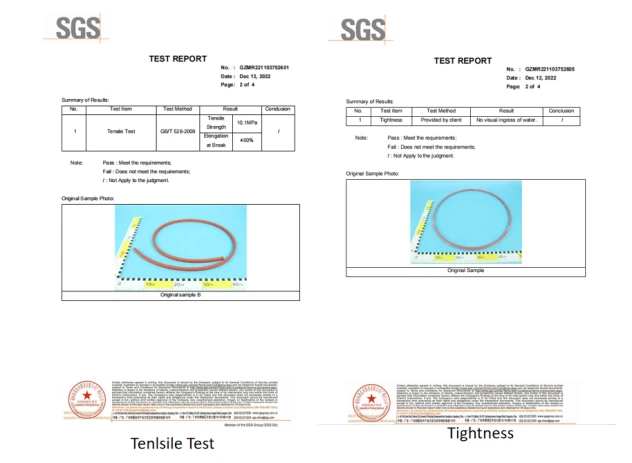
Our encapsulated O-rings have passed multiple performance verification tests, including:
- Food-grade certification for FEP materials;
- Food-grade certification for silicone core materials;
- High-temperature resistance testing reports;
- Sealing performance testing reports;
- Material composition certification documents.
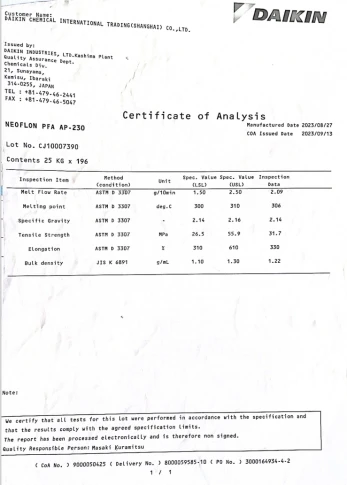
FDA of FEP Certification
Thanks to improved material selection and manufacturing technology, the average service life of our encapsulated O-rings is typically 30%-50% longer than standard products available on the market.
The longer service life significantly reduces replacement frequency, maintenance shutdowns and spare part inventory costs.
Excellent elasticity and aging resistance further reduce maintenance requirements and leakage-related labor costs.
More importantly, reliable sealing performance helps customers avoid cargo loss, environmental penalties and potential safety incidents caused by leakage failures - costs that often far exceed the price of the sealing component itself.
④ Comprehensive Service
We provide comprehensive pre-sales and after-sales support to help customers select the most suitable sealing solution for their applications.
- One-year product warranty;
- Sufficient inventory of standard sizes for immediate shipment;
- Green channel for urgent orders;
- Free material selection and technical consultation;
- Free small-batch samples for testing and verification;
- OEM and customized manufacturing services.
Based on the customer's media, temperature, pressure and installation conditions, our engineering team can recommend the optimal combination of encapsulation material and elastomer core to achieve the best balance between sealing reliability, service life and cost performance.


