


Gland packing is widely used for sealing pumps, valves, and rotating equipment because of its simple structure, easy maintenance, and adaptability to different operating conditions. According to industrial sealing standard operating procedures, correctly calibrated gland packing maintaining balanced radial pressure minimizes fluid bypass and achieves an optimized MTBF (Mean Time Between Failures) under standard operating parameters.
However, when leakage appears immediately after a new packing installation, the problem is almost always traceable to one of seven root causes. This diagnostic framework provides a systematic troubleshooting methodology mapped against API 682 shaft sealing specifications to identify root causes of immediate post-installation packing failures.
Cause 1: Incorrect Ring Cutting and Installation
Empirical field data indicates that incorrect ring cutting and improper joint alignment account for the highest percentage of immediate, premature packing seal failures before normal wear occurs. Even high-quality packing will leak if installed incorrectly.
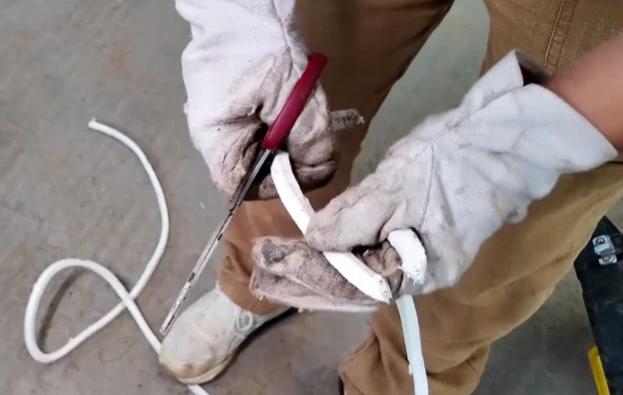
Symptoms: Leakage appears immediately upon startup, often from one side of the gland.
Rings cut too short leave gaps around the shaft.
Rings cut too long overlap and create uneven compression.
Aligned joints (not staggered by 90°) create a direct leakage path through all rings.
Rings not fully seated in the stuffing box create voids behind the gland follower.
Solution: Remove and reinstall the packing. Cut rings on a mandrel of the same diameter as the shaft. Stagger joints by 90 degrees between successive rings. Seat each ring firmly with a tamping tool before installing the next one.
SUNPASS supplies the gland packing cutting tool. It delivers precise butt and skive cuts, enabling high-quality packing installation with effortless, efficient operation.

Cause 2: Improper Compression Adjustment
Compression adjustment is a balancing act. It is the single largest factor in packing performance after installation.
Symptoms: If leakage is excessive, the gland may be too loose. If the stuffing box is hot to the touch, the gland is almost certainly too tight.
Under-tightening: packing does not expand radially against the shaft, leaving a leakage path.
Over-tightening: increases friction, generates excessive heat, accelerates wear, and can score the shaft.
Uneven tightening: one side of the gland follower is tighter than the other, creating uneven compression
Solution: Loosen the gland nuts completely and re-tighten using a cross-pattern sequence with a torque wrench. Follow the break-in procedure in our adjustment guide - tighten by 1/6 to 1/4 turn at a time, with 15-20 minute intervals between adjustments.
SUNPASS Supply the nut also,connect us if you need tools.

Cause 3: Wrong Packing Cross-Section Size
Packing size is determined by the radial gap between the shaft and the stuffing box bore, not by the shaft diameter alone.
Symptoms: Leakage persists regardless of how much the gland is tightened. Or, the packing cannot be inserted into the stuffing box at all.
Packing cross-section = (Stuffing box bore diameter − Shaft diameter) ÷ 2

Solution: Measure the stuffing box bore and shaft diameter accurately. Calculate the required cross-section. Do not attempt to "make it fit" by hammering oversized packing or shimming undersized packing. Replace with the correct size.
Cause 4: Damaged Shaft or Sleeve Surface
The shaft surface is the mating surface for the packing. Any damage creates a leakage path that no packing can seal.
Symptoms: Leakage from a specific angular position that does not change with gland adjustment. Visible scoring, pitting, or corrosion on the shaft or sleeve.
Wear grooves from previous packing create channels for fluid bypass.
Corrosion pitting on the shaft surface creates irregular sealing surfaces.
Excessive shaft runout or bearing wear causes the shaft to move off-center.
Solution: Inspect the shaft or sleeve under good lighting. If grooves are deeper than 0.1 mm, replace or re-machine the sleeve. For minor surface damage, a sleeve repair using a shaft repair sleeve may be acceptable. Check shaft runout with a dial indicator-per JB/T 6612-2008, the radial runout at the stuffing box should not exceed 0.05 mm TIR [6].
Cause 5: Wrong Packing Material for the Application
Different applications require different packing materials. A material that works well in one pump may fail quickly in another.
Symptoms: Rapid packing deterioration, chemical attack (swelling, softening, or disintegration), or carbonization of the packing material.
Key selection factors include fluid temperature, pressure, shaft speed, chemical compatibility, and the presence of abrasives. For detailed guidance, see our complete material selection guide: How to Select the Right Gland Packing Material.
Solution: Review the operating conditions against the packing manufacturer's application limits. If conditions exceed the packing's rated temperature range, pressure rating, or chemical compatibility, switch to a suitable material. Common upgrades include PTFE-impregnated packing for chemical resistance, graphite packing for high-temperature service, and aramid packing for abrasive slurries.
SUNPASS offers the following services during the purchasing process for packing products:
Operating Condition Compatibility Analysis: Based on parameters provided by the customer, such as pressure and temperature, we provide the optimal solution for packing material and braiding configuration.
2. Free small-batch samples;
3. Rapid Response Inventory: We maintain a safety stock of commonly used materials and specifications (such as graphite, aramid, and PTFE);
4. Fast-track service for urgent orders

Cause 6: Poor Packing Quality or Inconsistent Manufacturing
Variations in braid density, inconsistent lubricant distribution, and raw material cross-sectional tolerances directly impair the material's structural integrity, causing localized stress concentration and accelerated thermal degradation.
Symptoms: Some rings from the same batch perform differently, or the packing shows visible defects such as uneven braid density, inconsistent lubricant distribution, or loose fibers.
Solution: Source packing from manufacturers with documented quality control. Look for consistent braid density, even lubricant distribution, and clear dimensional accuracy. Higher-quality packing may cost more initially but reduces the cost of frequent replacements and unplanned downtime. For guidance on evaluating packing quality, see our material selection guide.
If you're looking for a high-quality packing supplier, choose SUNPASS. SUNPASS products are made from premium raw materials, offering excellent sealing performance, wear resistance, and resistance to aging. They are suitable for a wide range of industrial applications and come with sealing performance test reports, SGS and FDA certifications, temperature resistance test reports, and material composition certificates, all in compliance with industrial sealing material standards.
7: Operating Conditions Exceeding Design Parameters
Even perfectly installed and selected packing will fail if the pump operates outside its design envelope.
Symptoms: Packing fails repeatedly despite correct installation and material selection. Failure occurs at a predictable interval.
Pressure spikes exceeding the packing's rated pressure
Temperature excursions beyond the packing material's maximum service temperature
Pump cavitation causing vibration and shaft movement
Dry running or inadequate flush water to the stuffing box
Solution: Install pressure and temperature monitoring at the stuffing box. Verify that the flush water supply is adequate and uninterrupted. If operating conditions cannot be brought within the packing's rated range, consider upgrading to a mechanical seal or a higher-grade packing material.
SUNPASS also supply pressure and temperature monitoring.

The SUNPASS glass thermometers adopt organic kerosene or alcohol as temperature sensing media, with a measurable temperature range of -100°C to 200°C. Mercury thermometers further broaden this working range to -30°C ~ 600°C to accommodate a wider variety of industrial scenarios.
The SUNPASS Durable Industrial Pressure Gauge enables high-accuracy pressure measurement for numerous applications. Featuring rugged construction, the gauge can endure severe environments and sustain reliable, consistent precision.
Diagnostic Flowchart: Quick Reference
Use this systematic approach to diagnose the cause of packing leakage:
|
Check This First |
If Yes |
If No |
|
Is the gland follower parallel to the stuffing box face? |
Go to question 2 |
Cause 2: Uneven tightening. Loosen and re-tighten in cross-pattern. |
|
Is the leakage rate stable or getting worse? |
Go to question 3 |
It may be normal break-in. Continue monitoring per the adjustment guide. |
|
Does leakage come from all sides or one specific side? |
Go to question 4 |
Cause 4: Check shaft surface for damage at the leakage position. |
|
Was the packing the correct cross-section size? |
Go to question 5 |
Cause 3: Replace with correctly sized packing. |
|
Is the packing material rated for this application? |
Cause 1: Remove and check installation quality. |
Cause 5: Review material selection against operating conditions. |
7. Our Product Recommendations
Why choose us?
SUNPASS SEALING TECH, founded in 1979, has 178 employees. Relying on more than 40 years of mature technology and experience, it specializes in the production of industrial sealing and thermal insulation materials. SUNPASS has a high reputation and influence in the sealing industry at home and abroad.
SUNPASS has a modern professional workshop of 12000M2, with more than 20 production lines such as graphite products, PTFE products, sealing gland packing, sealing gasket, glass fiber products, ceramic fiber products, rubber products and so on.
Customers are located in more than 200 countries and regions such as China, Kuwait, Spain, Germany, France, the Netherlands, Saudi Arabia, Russia, the United States, Mexico, Brazil, Australia, South Korea, Japan, Thailand, Egypt, Belgium, etc.
Quality Raw Materials
Raw Material Traceability and Access Control:
Strict Supplier Audit and Management: We conduct technical, production, and quality system assessments of core raw material suppliers such as aramid fiber, carbon fiber, PTFE, and high-purity graphite, establishing a qualified supplier list. Made from high-quality raw materials, our products offer strong sealing, wear resistance, and aging resistance, suitable for various industrial scenarios and with strong operating condition tolerance: They possess excellent high-temperature resistance, low-temperature resistance, high-pressure resistance, and chemical corrosion resistance, and can operate stably in a wide temperature range of -50℃ to 280℃ and under high-pressure environments.

Batch Traceability System: All raw materials are assigned a unique batch number, recording their origin, specifications, and incoming inspection reports. Any finished product can be traced back to the batch of raw materials used, achieving full-chain traceability.
Production Control
Professional Quality Control Team: Led by engineers with backgrounds in materials science and mechanical engineering, all operators undergo rigorous training and certification before starting work. Utilizing a dense structural design, superior substrate characteristics, and high elasticity, a multi-layered sealing protection system is formed, effectively blocking the penetration paths of various media such as gases, liquids, and dust.

Product Quality Assurance: Possesses sealing test reports, SGS and FDA certificates, temperature resistance test reports, and material composition certification, meeting industrial sealing material standards.
Optimized multi-layer cross-braided configurations achieve near-zero fugitive emissions for static valve applications and strictly controlled micro-leakage lubrication rates (8 to 10 drops per minute) for dynamic rotating equipment.

Implementing raw materials with 40% to 60% longer operational lifespans reduces equipment downtime intervals and procurement overhead, correlating to a verifiable reduction in Total Cost of Ownership (TCO).
③ Comprehensive Service
Operating Condition Adaptation Analysis: Providing optimal matching solutions for packing materials and braiding methods based on customer-provided pressure and temperature conditions;
Free small-batch sampling;
Rapid Response Inventory: Maintaining safety stock of commonly used materials and specifications (such as graphite, aramid, PTFE)
;

Green channel for urgent orders
References
[1] API Std 682 R2022, "Pumps-Shaft Sealing Systems for Centrifugal and Rotary Pumps," 4th Edition, American Petroleum Institute, Washington, DC, 2022.
[2] API Std 610-2021, "Centrifugal Pumps for Petroleum, Petrochemical, and Natural Gas Industries," 12th Edition, American Petroleum Institute, Washington, DC, 2021.
[3] China Association of Petrochemical Equipment Management, "Pump Maintenance and Repair Procedures," CAPEPM, 2022. Available: http://www.capepem.org.cn/3291.html
[4] GB/T 13007, "Centrifugal Pumps - Test Methods," Standardization Administration of China, 2011.
[5] "Petrochemical Equipment Integrity and Leak-Free Standards," China Petroleum & Chemical Industry Federation.
[6] JB/T 6612-2008, "Static Seal and Packing Seal - Vocabulary," Ministry of Industry and Information Technology of China, 2008.
[7] Garlock Sealing Technologies, "Gland Packing Installation and Maintenance Guide," 2020.


